|
VERWOOD
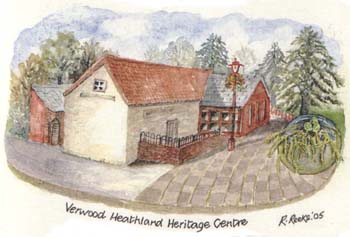
HEATHLAND HERITAGE CENTRE SITE OF THE CROSSROADS POTTERY
|

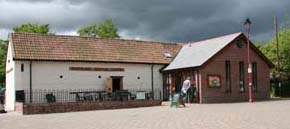
Verwood is situated in an area
of many clay seams, which supported numerous potteries and 5
brickworks. The date of construction is uncertain. The site
is evident on the Tithe Map of 1847 and at the recent
archaeological dig, manganese, glazed pottery from the 18th
century was discovered.
The drying shed building is of
cob construction, with foundations and floor of brick. The
cob walls were built using clay mixed with chopped heather,
furze and manure and put between boarding .about 3 feet
high. When that dried, the boards were moved up and another
layer added. These are called rearings and can still be seen
clearly.
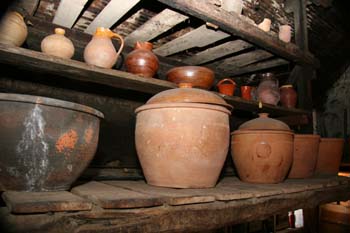 The building has two
storeys. The roof is tiled with a lining of heather
supported by battens. The exciting feature of the building
is that it still has the original roof with charred battens
and the drying racks in the upper storey remain. The building has two
storeys. The roof is tiled with a lining of heather
supported by battens. The exciting feature of the building
is that it still has the original roof with charred battens
and the drying racks in the upper storey remain.
Much of the clay dug in the
village was yellow. Some clay was dug nearby, from the
Ferrett Green site and the eastern side of the pottery. Blue
clay was brought by horse & cart & later steam
engine from near Holwell Mill, beyond the Heavy Horse
Centre. In latter years, blue clay came from Corfe Mullen.
The yellow clay was used for flower pots, as it was porous
and blue clay for pitchers and larger vessels, due to its
strength.
Clay was brought into the cob
building by barrow and put to soak in water, in a pit (now
under the boards). It was then dug out and stacked against
an inside wall, the remains of which are evident.
The clay was then mixed with
sand and water by a man using his bare feet, keeping himself
upright using a pole. The clay was ready for making.
This system was also used in the
brick lean-to, now demolished. The old brick floor and soak
pit can be seen in front of the restored building.
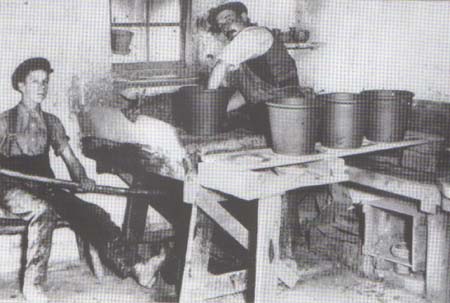 Two types of wheel were used. To
enable the potter to create his pot, his assistant, sitting
on an upturned pot, pushed and pulled a pole which, with a
simple mechanism, turned the wheel. The other type
functioned by an assistant turning a handle, similar to the
mechanism of a bicycle, which turned the wheel. Two types of wheel were used. To
enable the potter to create his pot, his assistant, sitting
on an upturned pot, pushed and pulled a pole which, with a
simple mechanism, turned the wheel. The other type
functioned by an assistant turning a handle, similar to the
mechanism of a bicycle, which turned the wheel.
Pots were created and dried
outside when the weather was suitable and in the drying shed
when wet.
On the site of April Cottage,
next door, was a large kiln mound containing two kiln
chambers. The kilns were stacked from the top of the mound,
the operators having to carry the pots up some steps and
then down a ladder inside to stack from the base of the
kiln. Firing took place for three days and nights.
There was a shop on this site,
but other ware, together with besom brooms were taken by
higglers with their horses and wagons as far afield as
Devon
and
Basingstoke
.
By 1920, due to the development
of enamel ware, the demand for Verwood ware declined. Fred
Fry took over with hopes to continue and in 1925, Robert
Thorne Ltd bought the site.
During the Second World War, Boy
Scout meetings were held in the room above the corridor and
toilets for Ladies and the Disabled.
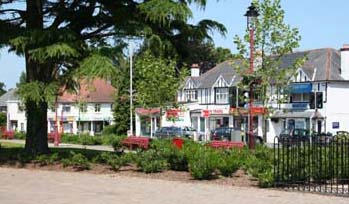
Ferrett Green from the Verwood Heritage
Centre
|