|
EAST DORSET AND
VERWOOD POTTERY INDUSTRY |
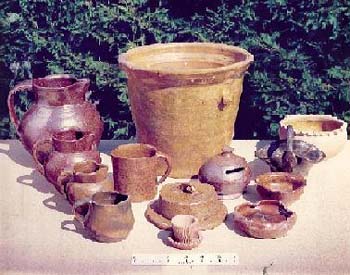
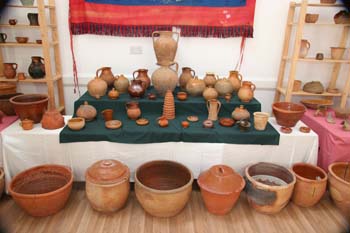
The East Dorset Pottery
Industry, known collectively as “VERWOOD POTTERY”
thrived from earliest time on the clay soils of the
neighbourhood and with ample firing material close at
hand. The major production was of domestic
earthenware although finer and more unusual pieces have been
found from earlier times. In the latter days
ornamental and novelty items were produced
Until the end of their
useful life, the methods of production had not varied from
Roman times, all the processes being carried out with no
mechanisation or electrification. For example,
the clay was always trodden by foot and not mixed in a pug
mill. The wheel was turned by an assistant with
a pole or handle. The kilns were wood
fired. As such the Crossroads Pottery, then the
last remaining in the area, attracted national and local
newspaper attention in the early to mid twentieth century.
The industry was not confined to a local
sales base. Hawkers, or “higglers”
took the wares for sale over a wide area of southern
England. It was also exported abroad, especially
to Newfoundland which had a thriving trade with the nearby
port of Poole.
The demise of the industry began when
railway transportation made lighter enamel ware from the
Midlands more widely available. Initially the
same means increased the distribution of Verwood Pottery
when a cart full was able to be sent ahead by train and
collected when the higgler had emptied his original
load. However, the stage was set for a radical
change in household utensils and demand for the heavier
pottery dwindled away.
One by one the potteries ceased
production, the last remaining being the Crossroads Pottery,
on a strategic route between neighbouring market towns,
whose doors finally closed in 1952.
Although the kiln mounds where the pottery
was fired have since been removed, the cob workshop with
drying racks above has remained in its original condition
and is the only example known of its kind.
It is not possible to say exactly when the
present workroom was constructed but it would have followed
a pattern handed down over generations. The site
has been documented at least from the early 19th century but
recent excavations have produced much material predating
1790. It is possible that the site, which had
its own adjacent clay pit, was in use even earlier than
this.
|
The
Crossroads Pottery in Verwood. |
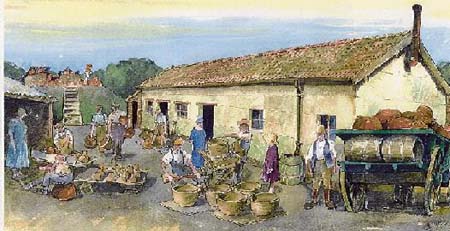
A BUSY DAY
This painting by Clive Daniels shows a
composite impression of the daily lives of the
potters; Treading clay, making pots, drying, unloading the
kiln after firing, demonstrating their wares and loading a
cart for export to the surrounding area.
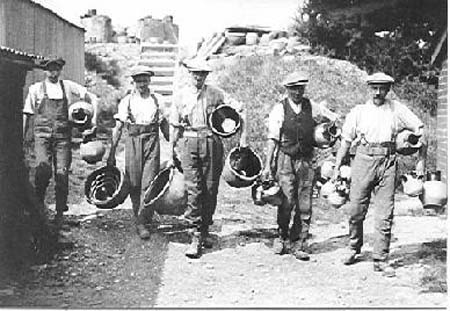
BELOW ARE JUST A FEW PHOTOGRAPHS FROM
THOSE DAYS
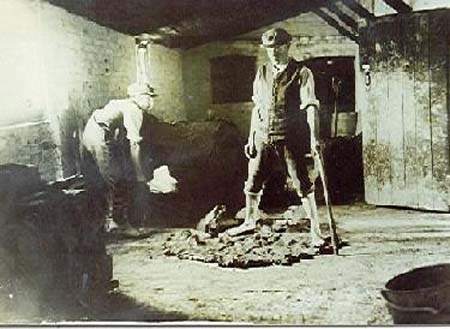 Treading the clay
Potter
Boy
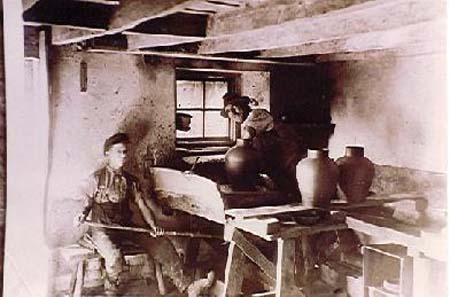
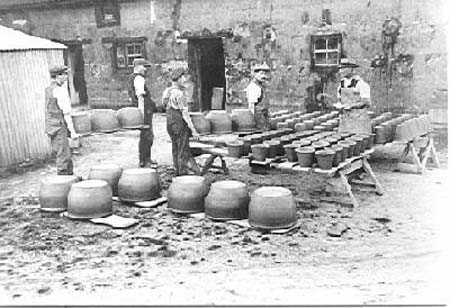 Drying Pots Outside Drying Pots Outside
Carrying Pots
MANY MORE ARE ON DISPLAY AT THE
HERITAGE CENTRE |